INFO
More Information About SanYue


Gear reduction motor is a power device that integrates a motor (usually an AC motor, DC motor, or stepper motor) with a gear reducer, and has the following core characteristics:
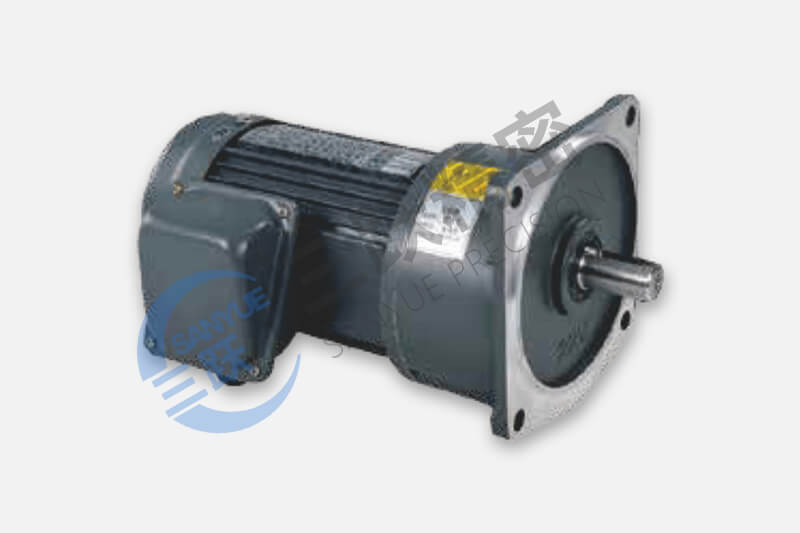
1. Reduce speed and increase torque
Core function: Reduce output speed and increase output torque through gear sets to meet the application requirements of low-speed and high torque.
Reduction ratio: fixed or adjustable (achieved through multi-stage gears), commonly ranging from a few: 1 to several hundred: 1, or even higher.
2. Efficiency and power transfer
Transmission efficiency: usually higher (single-stage gears can reach over 90%), but multi-stage gears will gradually reduce efficiency due to friction.
Power matching: Adapt motor power to avoid "big horse pulling small car" or overload.
3. Precise control characteristics
Positioning accuracy: When a stepper motor or servo motor is paired with a reducer, it can improve the accuracy of position control (such as in robotic arms, CNC equipment).
Start stop stability: Gear meshing reduces inertial impact, making start stop smoother.
4. Reliability and lifespan
Load capacity: Gear disperses load, extending motor life (especially suitable for heavy load or frequent start stop scenarios).
Materials and processes: Metal gears (such as steel and brass) are wear-resistant, while plastic gears are lightweight and low-noise.
5. Structural characteristics
Compact design: Integrated structure saves space and is suitable for installation in restricted scenarios.
Sealing: Some models have dustproof and waterproof (such as IP65) functions, suitable for harsh environments.
6. Noise and vibration
Noise level: depends on gear accuracy (helical gear noise is lower than spur gear) and lubrication status.
Vibration control: High precision gear and balance design can reduce vibration.
7. Application adaptability
Wide compatibility: Can be paired with various motors (such as AC induction motors, brushless DC motors, stepper motors).
Customization: The output shaft form (keyway, hollow shaft, etc.) and installation method (flange, base) can be customized.
8. Maintenance requirements
Lubrication requirements: Regular inspection of lubricating grease is required (some are maintenance free for life).
Wear monitoring: Gears may experience pitting or wear after long-term use and require regular inspection.
Typical application scenarios
Industrial equipment: conveyor belts, packaging machines, mixers.
Automation: robot joints, AGV drive.
Livelihood fields: electric curtains, automatic doors, medical equipment.
Key parameters for selection
Reduction ratio: calculated based on the required output speed/torque.
Rated torque: A margin should be left to prevent overload.
Return clearance: affects accuracy (precision transmission requires<1 arc minute).
Environmental temperature: Special lubrication and materials are required for high or low temperatures.
Through reasonable selection, gear reduction motors can effectively balance speed, torque, efficiency, and cost, and are one of the core components of power transmission systems.

Address:No. 6, Xinji Lane 1, Yuanjiayong, Zhongtang Town, Dongguan City, Guangdong Province
Website:https://www.sanyuejd.com
E-mail:service@sanyuejd.com

